
Description
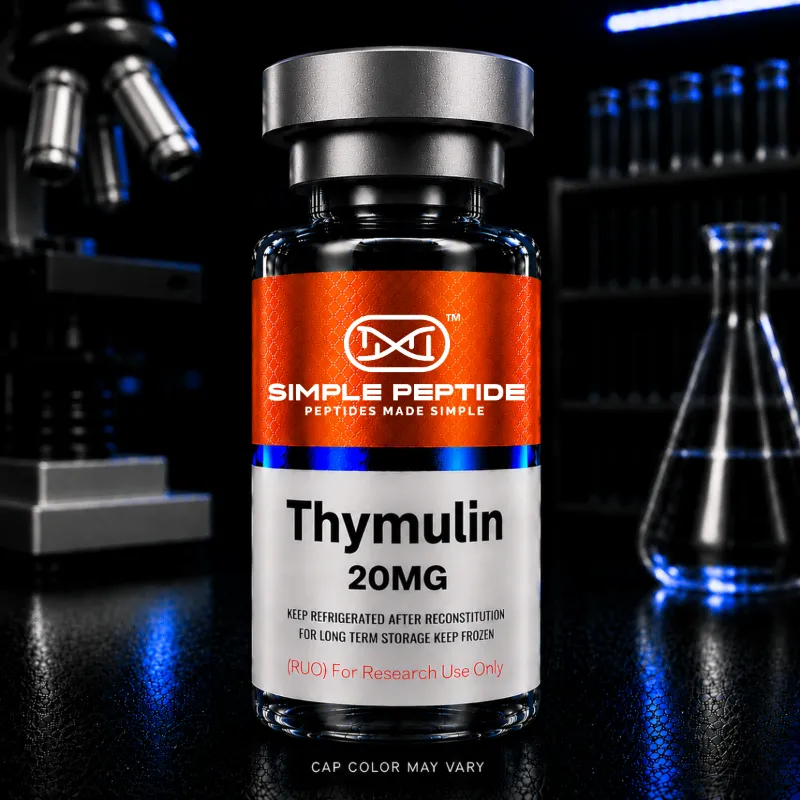
Our Thymulin 20mg vial holds 20mg of lyophilized Thymulin, a zinc-dependent thymic nonapeptide. It’s for in-vitro and lab research only.
What is Thymulin?
Thymulin is a nine-amino-acid peptide made by epithelial cells in the thymus. Jean-Francois Bach’s group in Paris described it in the 1970s as facteur thymique serique (FTS), a thymus factor found in blood.
It only works when it’s bound to zinc, which is why older papers separate the active zinc form from the inactive peptide. Blood levels fall with age as the thymus shrinks. It isn’t an approved medicine.
How Thymulin acts in the lab
Thymulin binds high-affinity receptors on T cells and pushes them through the later stages of maturation. Zinc holds the peptide in the shape that receptor recognizes.
It also talks to the neuroendocrine system. The pituitary hormones prolactin and growth hormone raise thymulin output, and thymulin in turn affects pituitary hormone release in animal studies.
Thymulin 20mg specifications
- Compound: Thymulin
- Also known as: facteur thymique serique, FTS
- CAS number: 63958-90-7
- Molecular formula: C33H54N12O15
- Molar mass: 858.9 g/mol
- Sequence: pGlu-Ala-Lys-Ser-Gln-Gly-Gly-Ser-Asn
- Amount: 20mg per vial
- Form: lyophilized (freeze-dried) powder
- Testing: third-party tested
- Documentation: Certificate of Analysis available
- SKU: SP-THYMU-20
- Use: laboratory research only
What the research says about Thymulin
Most of the early work looked at T cells: thymulin helps immature T cells mature and gain their surface markers, and levels drop in zinc deficiency and in older animals.
Later rodent studies looked at anti-inflammatory and pain effects, and a few groups used thymulin gene therapy in aging rats to study the link between the thymus and the brain’s hormone systems.
The primary literature is on PubMed, run by the US National Library of Medicine. Here’s a search for Thymulin studies to start from.
Thymulin 20mg vs related compounds
Here’s how Thymulin 20mg fits among related compounds. Thymulin is a zinc-dependent nine-amino-acid thymus hormone that helps T cells mature. By comparison:
- Thymosin Alpha-1 is a 28-amino-acid thymic peptide, approved in several countries as thymalfasin
- Thymalin is a calf-thymus peptide complex from Khavinson’s program, registered in Russia as an immune medicine
- LL-37 is the only human cathelicidin, an antimicrobial peptide that also signals in wound repair
- VIP is a 28-amino-acid neuropeptide that relaxes smooth muscle and calms immune cells
These are all studied in immune research, but at different points: the thymus peptides on T-cell maturation and signaling, LL-37 on direct antimicrobial action and VIP on calming inflammation. See them all on our immune peptides page.
Reconstituting Thymulin 20mg
The amount of liquid you add sets the concentration. For a vial holding 20mg:
- 1mL of bacteriostatic water gives 20mg/mL
- 2mL of bacteriostatic water gives 10mg/mL
- 3mL of bacteriostatic water gives 6.67mg/mL
Go with whichever number is easiest to work with in your protocol, and label the vial with the concentration and the date you mixed it.
Bacteriostatic water is the usual choice, and 0.6% acetic acid helps with peptides that won’t dissolve in water alone. Add it slowly so it runs down the side of the vial, then swirl or roll until everything dissolves. Shaking can shear peptide chains. Skip it.
Thymulin 20mg storage and shelf life
Freeze-dried Thymulin 20mg handles room temperature fine during shipping, but for anything longer keep it in a freezer at -20°C, away from light. Once mixed, keep it in the fridge at 2 to 8°C and use it within about four weeks.
Leave sealed vials sealed until you need them. Dry powder in a closed vial lasts far longer than solution, so there’s no reason to mix more than one at a time.
Third-party tested Thymulin 20mg
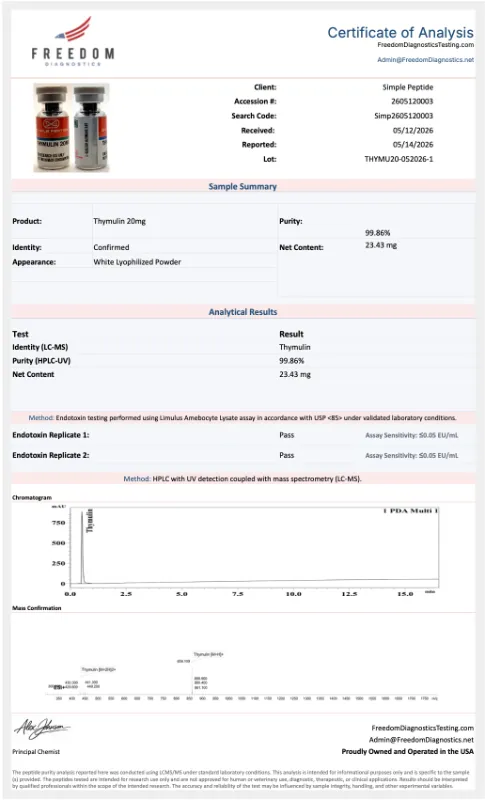
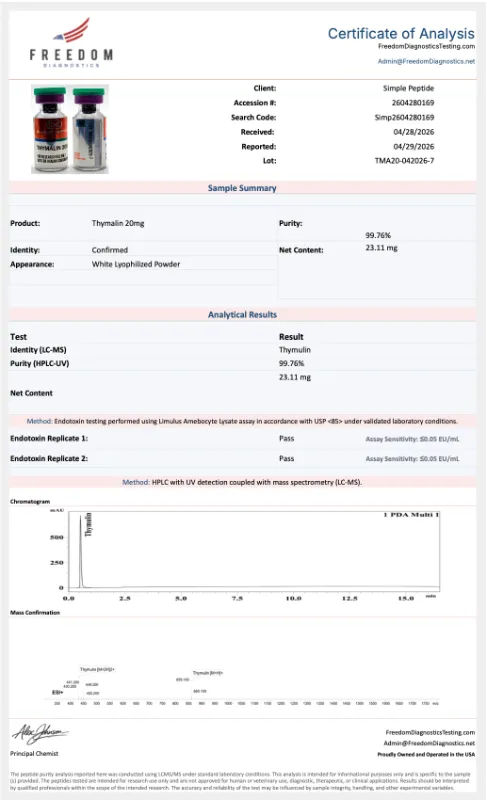
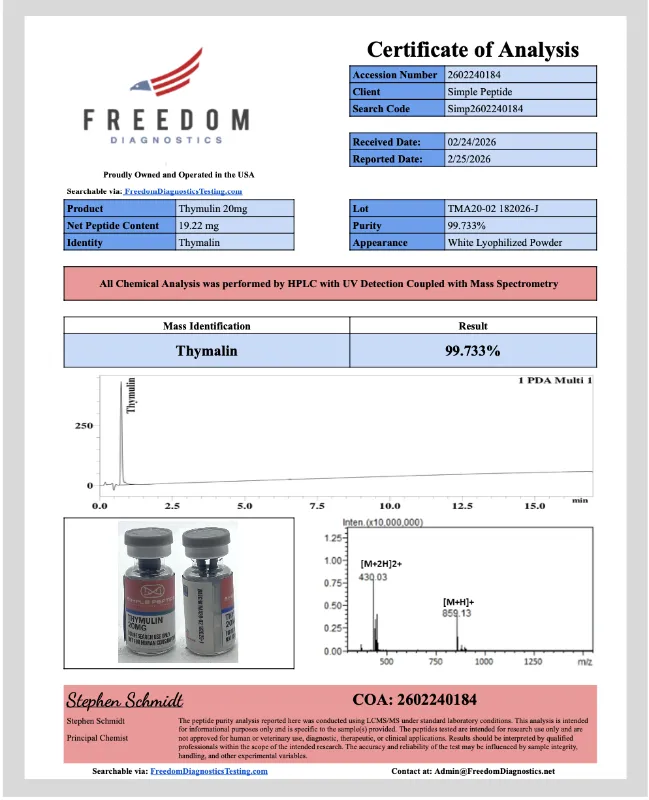
Simple Peptide sends Thymulin 20mg to an outside lab for identity and purity testing. The COA for the batch is available on request.
Labs normally confirm identity with mass spectrometry, which checks the molecular weight, and measure purity with HPLC, which separates the main compound from anything else in the sample.
If you run a long study, try to keep it on one batch and log the number from the label. It removes one variable from your results.
Often ordered with Thymulin 20mg
- Thymosin Alpha-1 10mg, a thymic peptide
- LL-37 10mg, an antimicrobial peptide
- VIP 5mg, a neuropeptide
- Melts Immunity Strips, 30 pre-measured strips per box
- ARA-290 10mg, an EPO-derived peptide
Browse the full immune peptides range, see every vial on our research peptides page or head back to the Simple Peptide home page.
Common questions about Thymulin 20mg
How much is in the Thymulin 20mg vial?
20mg of freeze-dried powder. The amount is printed on the label.
What do I mix Thymulin 20mg with?
Sterile bacteriostatic water is the usual choice. The reconstitution section above shows the concentration for each volume.
How should I store it?
Keep sealed vials in the freezer at -20°C. Once mixed, refrigerate at 2 to 8°C and use within about 28 days.
Can Thymulin be used in people or animals?
No. It’s sold for laboratory research only and isn’t approved for human or veterinary use.
Is Thymulin 20mg in stock?
Yes. Thymulin 20mg is in stock and ready to ship.
Buy Thymulin 20mg online
Ready to order? Thymulin 20mg costs $84.00 and is in stock. Use code SIMPLE10 for 10% off, and shipping costs nothing wherever you are.
Stocking up for a longer study? Choose 5 vials or 10 vials from the Quantity menu to save 5% or 10% on the single price. Need more for the same project? See the rest of our immune peptides, or go back to the Simple Peptide home page.
For laboratory research use only. Not for human or veterinary use. These statements have not been evaluated by the FDA.
Reviews
There are no reviews yet.