
Description
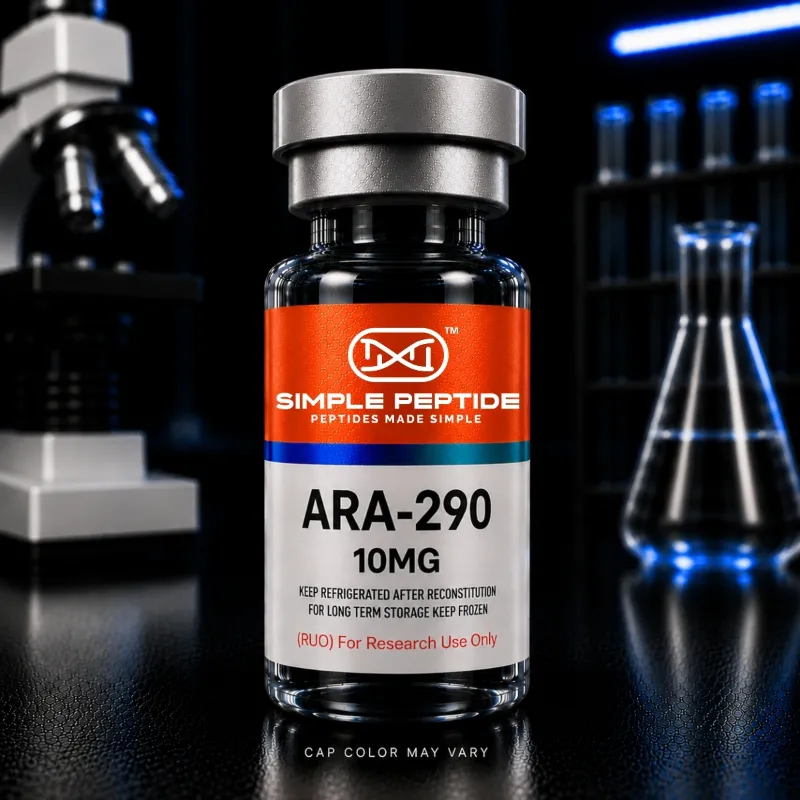
ARA-290 10mg is a 10mg vial of ARA-290, an erythropoietin-derived peptide, supplied as freeze-dried powder. It’s for in-vitro and lab research only.
What is ARA-290?
ARA-290 (cibinetide) is an 11-amino-acid peptide based on a region of erythropoietin. It activates the tissue-protective receptor without stimulating red blood cell production.
Araim Pharmaceuticals developed it for small fiber neuropathy.
How ARA-290 works
Erythropoietin (EPO) has two jobs. It drives red blood cell production through one receptor, and it protects tissue through another, a complex of the EPO receptor with CD131.
ARA-290 mimics the small part of EPO that binds the tissue-protective receptor and leaves the red blood cell receptor alone. That lets researchers study EPO’s anti-inflammatory and nerve-protective effects without raising hematocrit.
ARA-290 10mg specifications
- Compound: ARA-290
- Also known as: cibinetide
- CAS number: 1208243-50-8
- Molar mass: 1,257.3 g/mol
- Structure: 11 amino acids (pGlu-Glu-Gln-Leu-Glu-Arg-Ala-Leu-Asn-Ser-Ser)
- Amount: 10mg per vial
- Form: lyophilized (freeze-dried) powder
- Testing: third-party tested
- Documentation: Certificate of Analysis available
- SKU: SP-ARA290-10
- Use: laboratory research only
Published ARA-290 studies
In a phase 2 study, Brines and colleagues reported that ARA-290 improved symptoms and corneal nerve fiber density in patients with sarcoidosis-related small fiber neuropathy.
Animal studies looked at nerve and kidney protection.
The primary literature is on PubMed, run by the US National Library of Medicine. Here’s a search for ARA-290 studies to start from.
ARA-290 10mg vs related compounds
Here’s how ARA-290 10mg fits among related compounds. ARA-290 is an 11-amino-acid peptide from erythropoietin that protects tissue without raising red cells. By comparison:
- BPC-157 is the 15-amino-acid repair peptide with the largest body of rodent research
- TB-500 is the 43-amino-acid actin-binding protein, studied for cell movement and wound repair
- KPV is a three-amino-acid alpha-MSH fragment studied for calming inflammation
- GHK-Cu is the copper-binding tripeptide studied for collagen and skin repair
These are the main peptides in repair research. Each covers a different step, from blood vessel growth and cell movement to calming inflammation and rebuilding the skin matrix. See them all on our healing and recovery peptides page.
ARA-290 10mg purity and lab testing
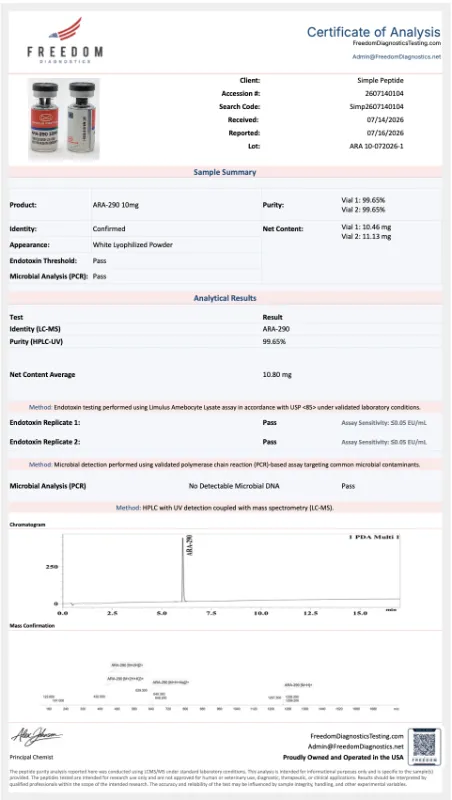
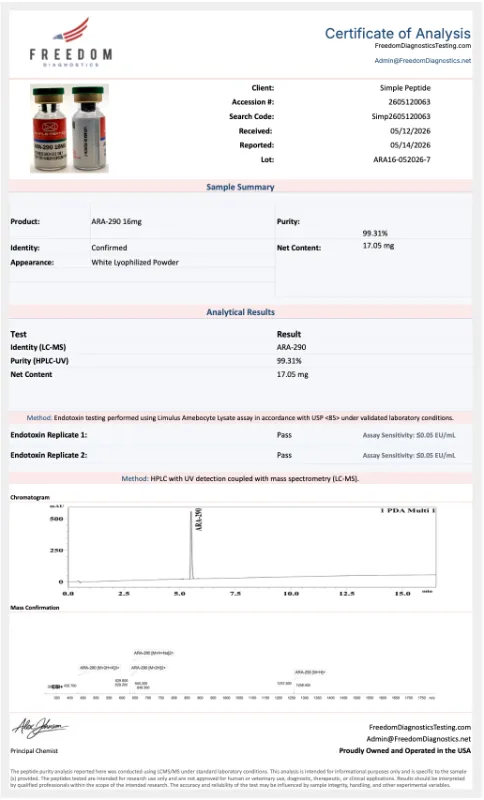
ARA-290 10mg is checked by an independent lab before it goes on sale. A Certificate of Analysis (COA) for the batch is available, and you can ask us for it with your order.
For peptides, purity is usually measured by HPLC, which separates a sample into its parts and reports the main compound as a share of the total. Mass spectrometry is often run alongside it to confirm the molecular weight.
Write the batch number from the label into your lab notes and keep the COA with them. If a result looks odd later, you can tie it back to the exact batch you used.
Reconstituting ARA-290 10mg
The amount of liquid you add sets the concentration. For a vial holding 10mg:
- 1mL of bacteriostatic water gives 10mg/mL
- 2mL of bacteriostatic water gives 5mg/mL
- 3mL of bacteriostatic water gives 3.33mg/mL
Pick the volume that keeps your own calculations simple, then write the concentration and the mixing date on the label.
Bacteriostatic water is the usual choice, and 0.6% acetic acid helps with peptides that won’t dissolve in water alone. Add it slowly so it runs down the side of the vial, then swirl or roll until everything dissolves. Shaking can shear peptide chains. Skip it.
Storing ARA-290 10mg
Freeze-dried ARA-290 10mg handles room temperature fine during shipping, but for anything longer keep it in a freezer at -20°C, away from light. Once mixed, keep it in the fridge at 2 to 8°C and use it within about four weeks.
Leave sealed vials sealed until you need them. Dry powder in a closed vial lasts far longer than solution, so there’s no reason to mix more than one at a time.
How many ARA-290 10mg vials do you need?
Work out the total amount before you order. Add up what each arm of the study uses across every time point, then divide by 10mg. Round up by one vial so a spoiled sample or a repeat run doesn’t stall the project.
Only reconstitute what you’ll use in the next few weeks. Sealed vials stay stable in the freezer, while a mixed vial should be finished within about 28 days.
Keep vials from one batch together in a study where you can. The batch number on the label ties each result back to the lab paperwork.
Often ordered with ARA-290 10mg
- GHK-Cu KPV Blend 60mg, GHK-Cu and KPV in one vial
- MGF 5mg, an IGF-1 splice variant peptide
- PEG-MGF 2mg, a pegylated MGF
- BPC-157 TB-500 Blend 5mg/5mg, BPC-157 and TB-500 in one vial
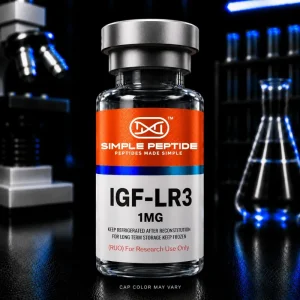
- IGF-1 LR3 1mg, an IGF-1 analog
Browse the full healing and recovery peptides and immune peptides range, see every vial on our research peptides page or head back to the Simple Peptide home page.
Common questions about ARA-290 10mg
How much is in the ARA-290 10mg vial?
10mg of freeze-dried powder. The amount is printed on the label.
Is ARA-290 10mg in stock?
Yes. This vial is in stock and ready to ship.
Can I buy ARA-290 10mg in bulk?
Yes. Pick 5 vials or 10 vials from the Quantity menu above the cart button.
Is ARA-290 10mg third-party tested?
Yes. Every batch is third-party tested, and the Certificate of Analysis is available on request.
What do I mix ARA-290 10mg with?
Sterile bacteriostatic water is the usual choice. The reconstitution section above shows the concentration for each volume.
Order ARA-290 10mg today
This vial is in stock at $76.00. Add it to the cart, enter code SIMPLE10 at checkout for 10% off, and shipping is free worldwide. Need water to mix it? Add bacteriostatic water to the same order.
Stocking up for a longer study? Choose 5 vials or 10 vials from the Quantity menu to save 5% or 10% on the single price. Need more for the same project? See the rest of our healing and recovery peptides and immune peptides, or go back to the Simple Peptide home page.
For laboratory research use only. Not for human or veterinary use. These statements have not been evaluated by the FDA.
Reviews
There are no reviews yet.