Description
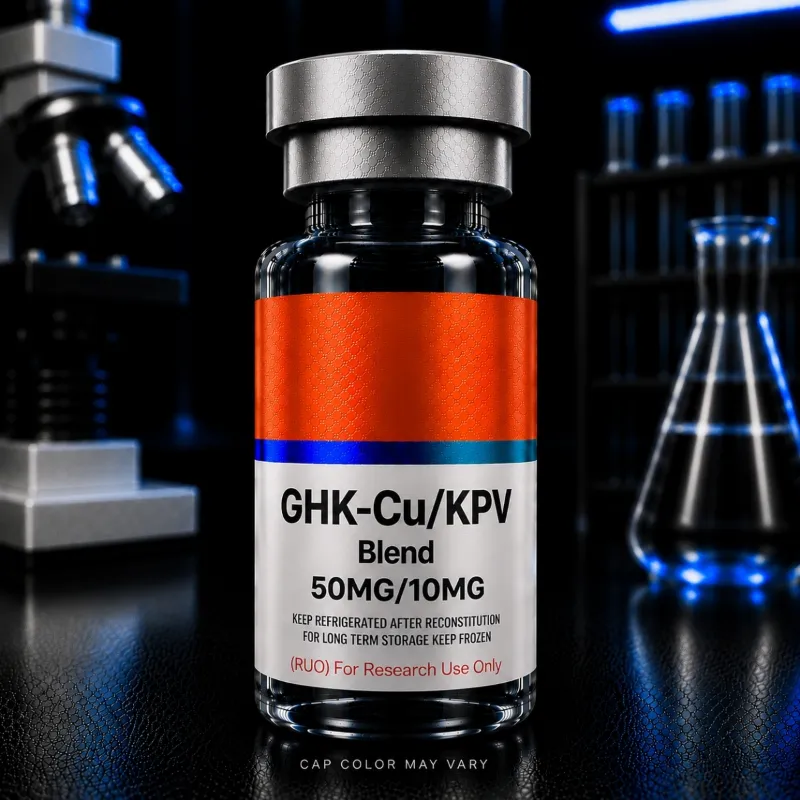
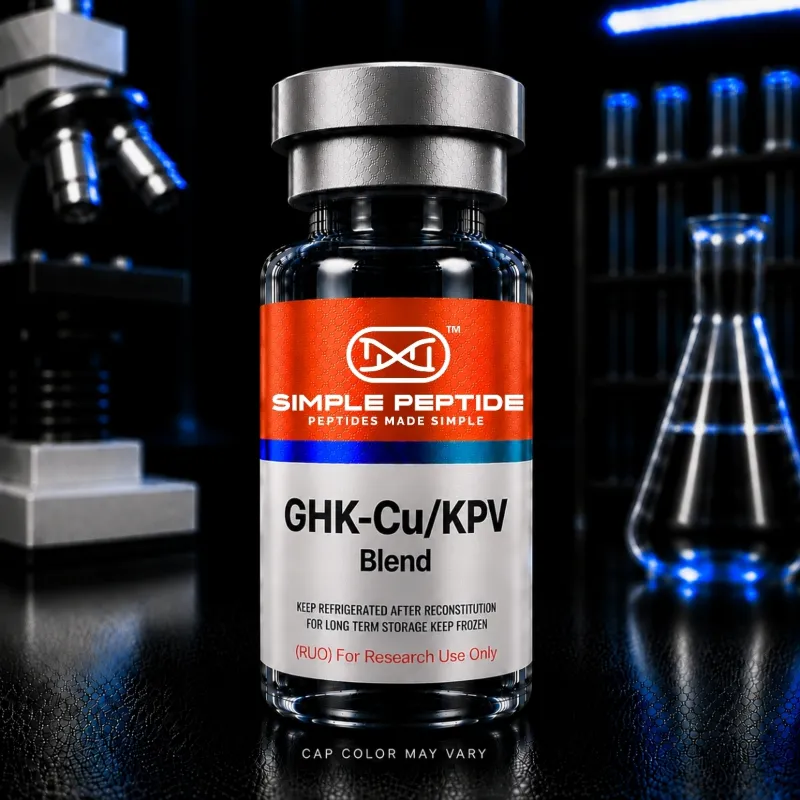
GHK-Cu KPV blend 60mg puts 50mg GHK-Cu and 10mg KPV into one sealed vial so you reconstitute once instead of two times. It’s sold for laboratory research only.
What the GHK-Cu KPV blend 60mg contains
GHK-Cu is the tripeptide glycyl-L-histidyl-L-lysine bound to a copper(II) ion. Loren Pickart first isolated GHK from human plasma in 1973, and levels in plasma are reported to fall with age.
KPV is the tripeptide lysine-proline-valine, the C-terminal end of alpha-melanocyte stimulating hormone. It keeps alpha-MSH’s anti-inflammatory activity without the pigment effects.
This blend skips the repair peptides and pairs GHK-Cu with KPV: the copper peptide for collagen and the alpha-MSH fragment for inflammation. It’s the simpler choice for skin models where both are being measured.
The vial holds 50mg GHK-Cu and 10mg KPV, 60mg in total. Because everything is freeze-dried together, the ratio can’t drift the way it can when you mix separate vials. One reconstitution, one label, the same proportions in every draw.
How the GHK-Cu KPV blend 60mg works
GHK binds copper tightly and can deliver it to cells. Copper is a cofactor for lysyl oxidase, the enzyme that cross-links collagen and elastin, and for antioxidant enzymes.
Alpha-MSH calms inflammation through melanocortin receptors. KPV is its last three amino acids and keeps much of that anti-inflammatory activity.
GHK-Cu KPV blend 60mg technical data
- GHK-Cu, 50mg: CAS 89030-95-5, C14H22CuN6O4, 401.9 g/mol
- KPV, 10mg: CAS 67727-97-3, C16H30N4O4, 342.4 g/mol
- Amount: 60mg in total (50mg/10mg per vial)
- Form: lyophilized (freeze-dried) powder
- Testing: third-party tested
- Documentation: Certificate of Analysis available
- SKU: SP-GHKKPV-60
- Use: laboratory research only
GHK-Cu KPV blend research
Maquart and colleagues reported in 1988 that GHK-Cu stimulated collagen synthesis in cultured fibroblasts, and later rat wound-chamber studies found more collagen and glycosaminoglycan buildup.
Gene expression work by Pickart and colleagues suggests GHK can shift the activity of a large number of human genes, many tied to tissue repair and the antioxidant response.
Dalmasso and colleagues reported in Gastroenterology (2008) that KPV reduced inflammation in mouse colitis models and was taken up through PepT1.
Laroui and colleagues later packaged KPV in nanoparticles and saw similar effects in mice.
For the original studies, try this PubMed search from the National Library of Medicine.
GHK-Cu and KPV in other formats
GHK-Cu and KPV also come in these products, in case a different format suits your study better:
- BPC-157 KPV Larazotide Capsules (capsules, $169.00)
- KPV 10mg (freeze-dried vial, $45.00)
- GHK-Cu 100mg (freeze-dried vial, $55.00)
Reconstituting GHK-Cu KPV blend 60mg
The amount of liquid you add sets the concentration. For a vial holding 60mg:
- 2mL of bacteriostatic water gives 30mg/mL
- 3mL of bacteriostatic water gives 20mg/mL
- 5mL of bacteriostatic water gives 12mg/mL
Go with whichever number is easiest to work with in your protocol, and label the vial with the concentration and the date you mixed it.
Use sterile bacteriostatic water, like our bacteriostatic water. Let the vial reach room temperature, run the water slowly down the inside of the glass, then roll the vial gently until the powder dissolves. Don’t shake it. Shaking can shear peptide chains.
How to store GHK-Cu KPV blend 60mg
Freeze-dried GHK-Cu KPV blend 60mg handles room temperature fine during shipping, but for anything longer keep it in a freezer at -20°C, away from light. Once mixed, keep it in the fridge at 2 to 8°C and use it within about four weeks.
Running several vials at once? Our peptide vial storage case holds ten 3mL vials upright in separate wells, which keeps a fridge shelf tidy and the labels easy to read.
How GHK-Cu KPV blend 60mg is tested
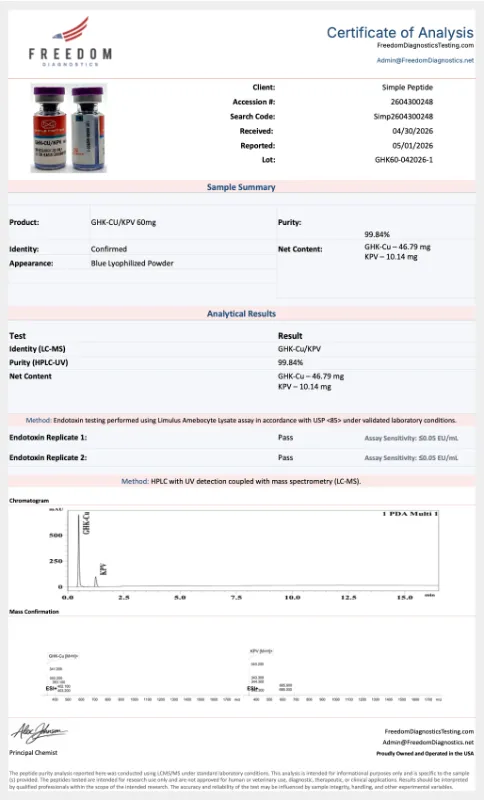
Every GHK-Cu KPV blend 60mg batch is third-party tested, and the Certificate of Analysis that goes with your batch is available on request.
The standard methods are HPLC for purity and mass spectrometry for identity. HPLC splits the sample and reports the main peak as a percentage, while mass spec confirms that peak has the right molecular weight.
Write the batch number from the label into your lab notes and keep the COA with them. If a result looks odd later, you can tie it back to the exact batch you used.
Other skin and tanning peptides to look at
- MOTS-c GHK-Cu KPV Blend 85mg, MOTS-c, GHK-Cu and KPV in one vial
- KLOW Blend 80mg (GHK-Cu, BPC-157, TB-500, KPV), GHK-Cu, BPC-157, TB-500 and KPV in one vial
- Melanotan 1 10mg, an alpha-MSH analog
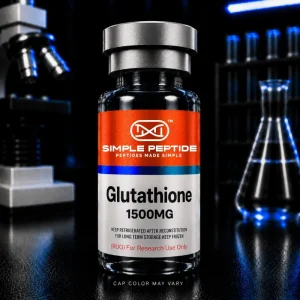
- Glutathione 1500mg, an antioxidant tripeptide
- GLOW Blend 70mg (GHK-Cu, BPC-157, TB-500), GHK-Cu, BPC-157 and TB-500 in one vial
Browse the full skin and tanning peptides and healing and recovery peptides range, see every vial on our research peptides page or head back to the Simple Peptide home page.
Common questions about GHK-Cu KPV blend 60mg
How much is in the GHK-Cu KPV blend 60mg vial?
50mg of GHK-Cu and 10mg of KPV, freeze-dried together. The amount is printed on the label.
Can GHK-Cu KPV blend be used in people or animals?
No. It’s sold for laboratory research only and isn’t approved for human or veterinary use.
Is GHK-Cu KPV blend 60mg in stock?
Yes. GHK-Cu KPV blend 60mg is in stock and ready to ship.
Can I buy GHK-Cu KPV blend 60mg in bulk?
Yes. Pick 5 vials or 10 vials from the Quantity menu above the cart button.
Is GHK-Cu KPV blend 60mg third-party tested?
Yes. Every batch is third-party tested, and the Certificate of Analysis is available on request.
Buy GHK-Cu KPV blend 60mg from Simple Peptide
Ready to order? GHK-Cu KPV blend 60mg costs $65.00 and is in stock. Use code SIMPLE10 for 10% off, and shipping costs nothing wherever you are.
Stocking up for a longer study? Choose 5 vials or 10 vials from the Quantity menu to save 5% or 10% on the single price. Need more for the same project? See the rest of our skin and tanning peptides and healing and recovery peptides, or go back to the Simple Peptide home page.
For laboratory research use only. Not for human or veterinary use. These statements have not been evaluated by the FDA.
Reviews
There are no reviews yet.