
Description
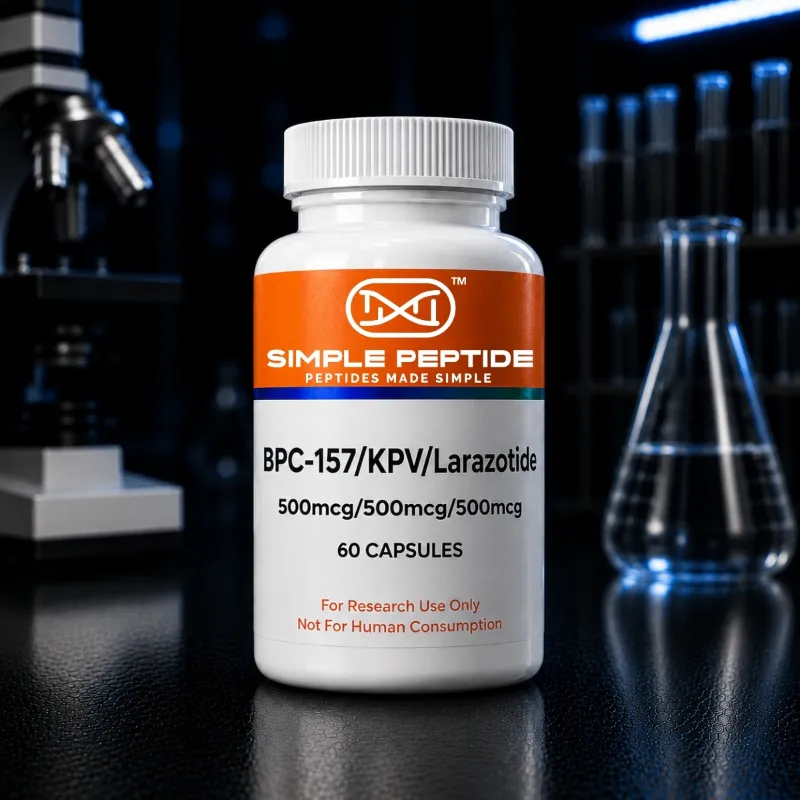
Each capsule in BPC-157 KPV Larazotide capsules contains 500mcg BPC-157, 500mcg KPV and 500mcg Larazotide. Simple Peptide sells it for lab research use.
BPC-157 KPV Larazotide capsules contents
- BPC-157: 500mcg per capsule, 30mg per bottle
- KPV: 500mcg per capsule, 30mg per bottle
- Larazotide: 500mcg per capsule, 30mg per bottle
The bottle holds 60 capsules. Multiply the per-capsule amount by 60 and you have the total for the bottle, which helps when you’re working out how many bottles a study needs.
BPC-157 in brief
BPC-157 is a 15-amino-acid peptide based on a fragment of body protection compound, a protein first found in gastric juice. It’s one of the most widely studied research peptides, almost entirely in rodents.
Nobody has pinned down a single receptor for BPC-157. Lab studies point to several pathways: it raises VEGF receptor expression, which feeds blood vessel growth, it interacts with the nitric oxide system, and it increases growth hormone receptor levels in tendon cells.
About KPV
KPV is the tripeptide lysine-proline-valine, the C-terminal end of alpha-melanocyte stimulating hormone. It keeps alpha-MSH’s anti-inflammatory activity without the pigment effects.
Alpha-MSH calms inflammation through melanocortin receptors. KPV is its last three amino acids and keeps much of that anti-inflammatory activity.
Larazotide in brief
Larazotide is an eight-amino-acid peptide, Gly-Gly-Val-Leu-Val-Gln-Pro-Gly, derived from a protein made by the cholera bacterium. It was developed to keep the tight junctions between gut lining cells closed.
Gliadin and some bacteria trigger release of zonulin, a protein that loosens tight junctions between intestinal cells. Larazotide is thought to block that step and help the junction proteins return to their place.
Oral research with BPC-157
BPC-157 is a slightly unusual case among peptides: it was first isolated from gastric juice and is reported to stay stable in it, which is why oral BPC-157 shows up in rodent gut studies.
Keep in mind that digestion breaks down many peptides, so a capsule study measures something different from a study using a reconstituted vial. Treat the two formats as separate variables.
BPC-157 KPV Larazotide capsules specifications
- Count: 60 capsules per bottle
- Amount per capsule: 500mcg BPC-157, 500mcg KPV and 500mcg Larazotide
- BPC-157, 500mcg: CAS 137525-51-0, C62H98N16O22, 1,419.5 g/mol
- KPV, 500mcg: CAS 67727-97-3, C16H30N4O4, 342.4 g/mol
- Larazotide, 500mcg: CAS 258818-34-7, C32H55N9O10, 725.8 g/mol
- Testing: third-party tested
- Documentation: Certificate of Analysis available
- SKU: SP-CAP-BPCKPVLAR
- Use: laboratory research only
Research behind BPC-157 KPV Larazotide capsules
Most of the work comes from Predrag Sikiric’s group at the University of Zagreb. Their rodent studies report faster healing of tendon, ligament, muscle and gut injuries, and Mikus and colleagues described improved burn wound healing in mice.
Dalmasso and colleagues reported in Gastroenterology (2008) that KPV reduced inflammation in mouse colitis models and was taken up through PepT1.
Phase 2 trials in people with celiac disease on a gluten-free diet, including one published in Gastroenterology in 2015, reported fewer symptoms at the lowest dose tested than with placebo.
For the original papers, start with this PubMed search for BPC-157, KPV and Larazotide from the National Library of Medicine.
How many bottles of BPC-157 KPV Larazotide capsules?
Add up how many capsules every arm of the study uses, from first time point to last, and divide by 60 to get the number of bottles. It’s worth keeping one spare for a repeat.
Keep capsules from the same batch within one study if you can. The batch number is on the label, and matching it across arms removes one variable from your results.
Capsules or vials?
A capsule is measured once, at the factory. You don’t weigh powder, add water or work out a concentration, and the amount in each unit is the same from the first capsule to the last. That removes a whole step where small errors creep into a study.
If your protocol calls for a reconstituted solution instead, the same compound comes as BPC-157 10mg and BPC-157 15mg in freeze-dried form. Many labs keep both on hand and run the formats as separate arms.
How BPC-157 KPV Larazotide capsules are tested
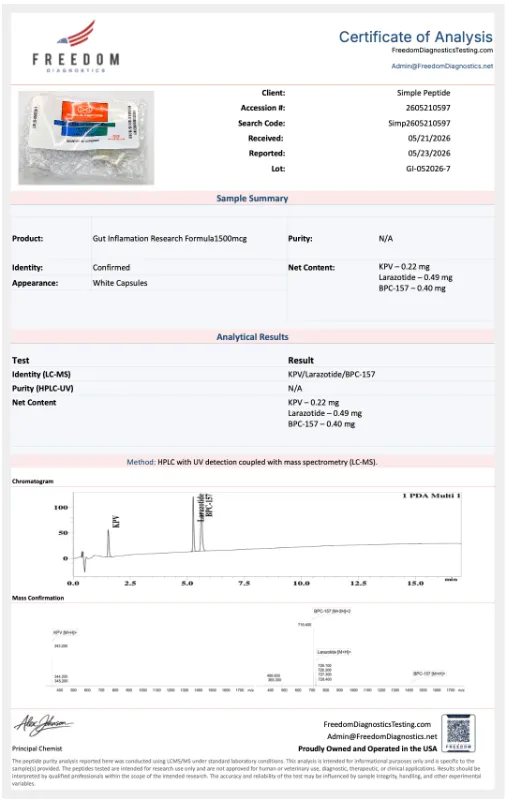
Simple Peptide sends BPC-157 KPV Larazotide capsules to an outside lab for identity and purity testing. The COA for the batch is available on request.
For peptides, purity is usually measured by HPLC, which separates a sample into its parts and reports the main compound as a share of the total. Mass spectrometry is often run alongside it to confirm the molecular weight.
Write the batch number from the label into your lab notes and keep the COA with them. If a result looks odd later, you can tie it back to the exact batch you used.
How to store BPC-157 KPV Larazotide capsules
Keep the bottle closed tight at room temperature or in the fridge, away from heat, light and moisture. Leave any desiccant packet inside. Capsules don’t need reconstituting, so there’s no mixed solution to use up.
Other ways to buy BPC-157
BPC-157 also comes in these products, in case a different format suits your study better:
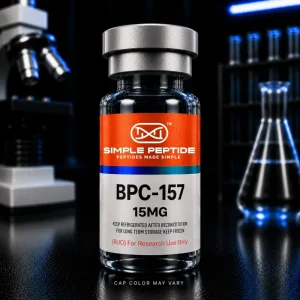
- BPC-157 10mg (freeze-dried vial, $55.00)
- BPC-157 15mg (freeze-dried vial, $75.00)
- BPC-157 20mg (freeze-dried vial, $85.00)
- BPC-157 TB-500 Blend 5mg/5mg (blend vial, $52.00)
- BPC-157 TB-500 Blend 10mg/10mg (blend vial, $84.00)
- BPC-157 TB-500 Blend 15mg/15mg (blend vial, $99.00)
Often ordered with BPC-157 KPV Larazotide capsules
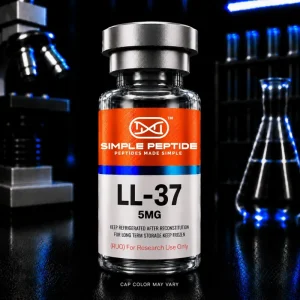
- LL-37 10mg, an antimicrobial peptide
- PEG-MGF 2mg, a pegylated MGF
- BPC-157 10mg, a 15-amino-acid peptide
- BPC-157 Ac-SDKP Capsules, a capsule format
- GHK-Cu KPV Blend 60mg, GHK-Cu and KPV in one vial
Browse the full healing and recovery peptides and immune peptides range, see every vial on our research peptides page or head back to the Simple Peptide home page.
BPC-157 KPV Larazotide capsules questions
Are BPC-157 KPV Larazotide capsules third-party tested?
Yes. Every batch is third-party tested, and the Certificate of Analysis is available on request.
How many capsules are in a bottle of BPC-157 KPV Larazotide capsules?
60. Each capsule holds 500mcg BPC-157, 500mcg KPV and 500mcg Larazotide.
Do the capsules need mixing?
No. They’re ready to use as they are, with no reconstitution step.
Can BPC-157 be used in people or animals?
No. It’s sold for laboratory research only and isn’t approved for human or veterinary use.
Are BPC-157 KPV Larazotide capsules in stock?
Yes. BPC-157 KPV Larazotide capsules are in stock and ready to ship.
Buy BPC-157 KPV Larazotide capsules online
Ready to order? BPC-157 KPV Larazotide capsules cost $169.00 and is in stock. Use code SIMPLE10 for 10% off, and shipping costs nothing wherever you are.
Stocking up for a longer study? Choose 5 bottles or 10 bottles from the Quantity menu to save 5% or 10% on the single price. Need more for the same project? See the rest of our healing and recovery peptides and immune peptides, or go back to the Simple Peptide home page.
For laboratory research use only. Not for human or veterinary use. These statements have not been evaluated by the FDA.
Reviews
There are no reviews yet.