
Description
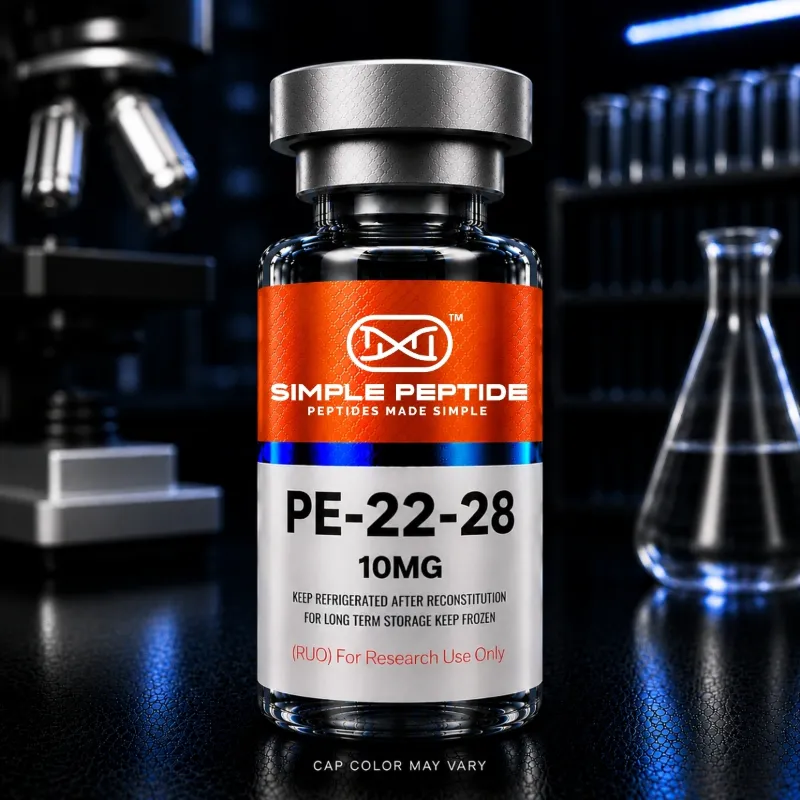
PE-22-28 10mg is a 10mg vial of PE-22-28, a seven-amino-acid spadin analog, supplied as freeze-dried powder. It’s for in-vitro and lab research only.
PE-22-28 at a glance
PE-22-28 is a seven-amino-acid peptide, Gly-Val-Ser-Trp-Gly-Leu-Arg, shortened from spadin. Spadin comes from the propeptide of sortilin, a protein involved in moving other proteins around inside neurons.
It was developed by Jean Mazella’s group in France as a more stable version of spadin. It’s a research compound only.
How PE-22-28 works
PE-22-28 blocks TREK-1, a potassium channel that keeps neurons quiet. Mice lacking TREK-1 are resistant to depression-like behavior in standard tests, which is what made the channel a target.
In the mouse studies, blocking it also raised markers of new neuron formation in the hippocampus.
PE-22-28 10mg product details
- Compound: PE-22-28
- Also known as: spadin analog
- Sequence: Gly-Val-Ser-Trp-Gly-Leu-Arg
- Amount: 10mg per vial
- Form: lyophilized (freeze-dried) powder
- Testing: third-party tested
- Documentation: Certificate of Analysis available
- SKU: SP-PE2228-10
- Use: laboratory research only
PE-22-28 research
Mazella and colleagues described spadin in PLoS Biology in 2010 as a blocker of the TREK-1 potassium channel with antidepressant-like effects in mice.
In 2017, Djillani and colleagues reported shorter analogs, including PE-22-28, that lasted longer and showed similar effects in mouse models within four days.
For the original studies, try this PubMed search from the National Library of Medicine.
PE-22-28 compared with similar compounds
PE-22-28 10mg is easier to place once you see it next to the compounds it’s usually compared with. PE-22-28 is a short spadin analog that blocks the TREK-1 potassium channel. The others:
- Semax is built on a fragment of ACTH and linked to BDNF in rodent studies
- Selank is built on tuftsin and studied for anxiety through the GABA system
- DSIP is a nine-amino-acid peptide first isolated from rabbits in deep sleep
- P21 is a small CNTF-derived peptide studied in Alzheimer’s mouse models for new neuron growth
These are studied for the brain but through very different routes: BDNF, the GABA system, sleep, a potassium channel and CNTF-style neurotrophic signaling. See them all on our nootropic peptides page.
Third-party tested PE-22-28 10mg
Simple Peptide sends PE-22-28 10mg to an outside lab for identity and purity testing. The COA for the batch is available on request.
The standard methods are HPLC for purity and mass spectrometry for identity. HPLC splits the sample and reports the main peak as a percentage, while mass spec confirms that peak has the right molecular weight.
If you run a long study, try to keep it on one batch and log the number from the label. It removes one variable from your results.
How to reconstitute PE-22-28 10mg
Concentration is the amount in the vial divided by the volume of water you add. With 10mg of powder in this vial:
- 1mL of bacteriostatic water gives 10mg/mL
- 2mL of bacteriostatic water gives 5mg/mL
- 3mL of bacteriostatic water gives 3.33mg/mL
Choose the volume that suits your measurements. Mark the vial with the concentration and date so nobody has to guess later.
Use sterile bacteriostatic water, like our bacteriostatic water. Let the vial reach room temperature, run the water slowly down the inside of the glass, then roll the vial gently until the powder dissolves. Don’t shake it. Shaking can shear peptide chains.
PE-22-28 10mg storage and shelf life
The dry powder keeps best cold and dark. A freezer at -20°C is right for long-term storage. After reconstitution, store it in the fridge at 2 to 8°C and finish it within roughly four weeks.
Leave sealed vials sealed until you need them. Dry powder in a closed vial lasts far longer than solution, so there’s no reason to mix more than one at a time.
Ordering PE-22-28 10mg for a full study
Start from the protocol. Total the amount every arm needs from the first time point to the last, divide by the 10mg in a vial and add a spare. It’s cheaper to order once than to wait on a second shipment halfway through.
Only reconstitute what you’ll use in the next few weeks. Sealed vials stay stable in the freezer, while a mixed vial should be finished within about 28 days.
If you order more than one vial, check that the batch numbers match before you start. Running a whole study on one batch removes one variable.
Often ordered with PE-22-28 10mg
- Semax 10mg, an ACTH(4-10) analog
- Melts Pro Selank Semax Strips, 30 pre-measured strips per box
- Pinealon 10mg, a bioregulator peptide
- P21 10mg, a neurotrophic peptide
- Dihexa Capsules 5mg, a capsule format
Browse the full nootropic peptides range, see every vial on our research peptides page or head back to the Simple Peptide home page.
PE-22-28 10mg questions
How much is in the PE-22-28 10mg vial?
10mg of freeze-dried powder. The amount is printed on the label.
Can I buy PE-22-28 10mg in bulk?
Yes. Pick 5 vials or 10 vials from the Quantity menu above the cart button.
Is PE-22-28 10mg third-party tested?
Yes. Every batch is third-party tested, and the Certificate of Analysis is available on request.
What do I mix PE-22-28 10mg with?
Sterile bacteriostatic water is the usual choice. The reconstitution section above shows the concentration for each volume.
How should I store it?
Keep sealed vials in the freezer at -20°C. Once mixed, refrigerate at 2 to 8°C and use within about 28 days.
Buy PE-22-28 10mg online
Ready to order? PE-22-28 10mg costs $72.00 and is in stock. Use code SIMPLE10 for 10% off, and shipping costs nothing wherever you are.
Stocking up for a longer study? Choose 5 vials or 10 vials from the Quantity menu to save 5% or 10% on the single price. Need more for the same project? See the rest of our nootropic peptides, or go back to the Simple Peptide home page.
For laboratory research use only. Not for human or veterinary use. These statements have not been evaluated by the FDA.
Reviews
There are no reviews yet.