Description
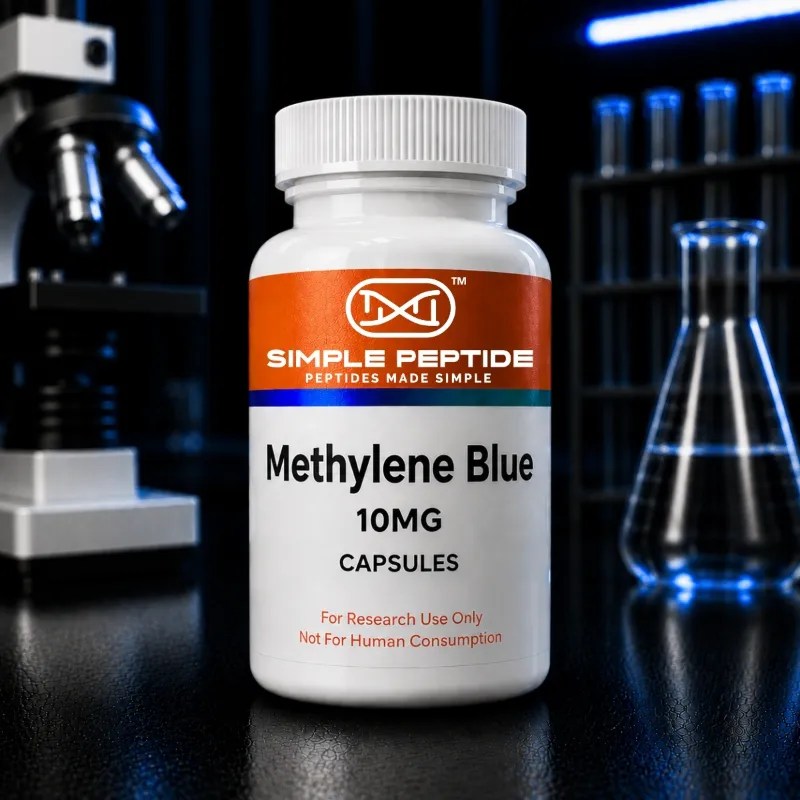
Methylene Blue capsules are a bottle of capsules, each holding 10mg Methylene Blue. It’s sold for laboratory research only.
Methylene Blue capsules contents
- 10mg Methylene Blue per capsule
Each capsule carries the same fixed amount. Check the count on the bottle label and multiply to get the total for the bottle, which helps when you’re working out how many bottles a study needs.
What is Methylene Blue?
Methylene blue is a blue dye first made by Heinrich Caro in 1876. It’s one of the oldest synthetic drugs and is still approved in the US, as ProvayBlue, for treating methemoglobinemia.
It dissolves in water and switches easily between its blue oxidized form and its colorless reduced form, leucomethylene blue. That redox behavior is why it’s used in so many lab assays.
At low concentrations methylene blue can accept electrons from NADH and hand them to cytochrome c, bypassing parts of the mitochondrial electron transport chain. That can keep energy production going when complex I or III is impaired.
It’s also a strong inhibitor of monoamine oxidase A, which matters for any study combining it with compounds that raise serotonin.
Oral research with Methylene Blue
Methylene blue is a small molecule that was given by mouth in much of the clinical and rodent work on it, so a capsule matches how it has been studied.
Keep in mind that digestion breaks down many peptides, so a capsule study measures something different from a study using a reconstituted vial. Treat the two formats as separate variables.
Methylene Blue capsules product details
- Amount per capsule: 10mg Methylene Blue
- Compound: Methylene Blue
- Also known as: methylthioninium chloride
- CAS number: 61-73-4
- Molecular formula: C16H18ClN3S
- Molar mass: 319.9 g/mol
- Testing: third-party tested
- Documentation: Certificate of Analysis available
- SKU: SP-CAP-MB-10
- Use: laboratory research only
Methylene Blue research
Paul Ehrlich used it in the 1890s to stain nerve tissue and to treat malaria, the first time a synthetic compound was used against a specific disease.
More recent work has looked at its effect on mitochondria and memory in rodents. A 2012 review by Rojas, Bruchey and Gonzalez-Lima in Progress in Neurobiology summarizes that research.
For the original papers, start with this PubMed search for Methylene Blue from the National Library of Medicine.
How many bottles of Methylene Blue capsules?
Add up how many capsules every arm of the study uses, from first time point to last, and divide by the count on the bottle label to get the number of bottles. It’s worth keeping one spare for a repeat.
Try to run a whole study from one batch. Write the batch number from the label in your notes so results can be traced back to the paperwork.
Capsules or vials?
The big advantage of capsules is that the measuring is already done. Every capsule carries the same amount, so there’s no reconstitution math, no syringe and no mixed solution with a use-by date.
Capsules also travel and store more easily than vials. A sealed bottle keeps at room temperature, so there’s no freezer space to find and no cold chain to manage between deliveries.
How Methylene Blue capsules are tested
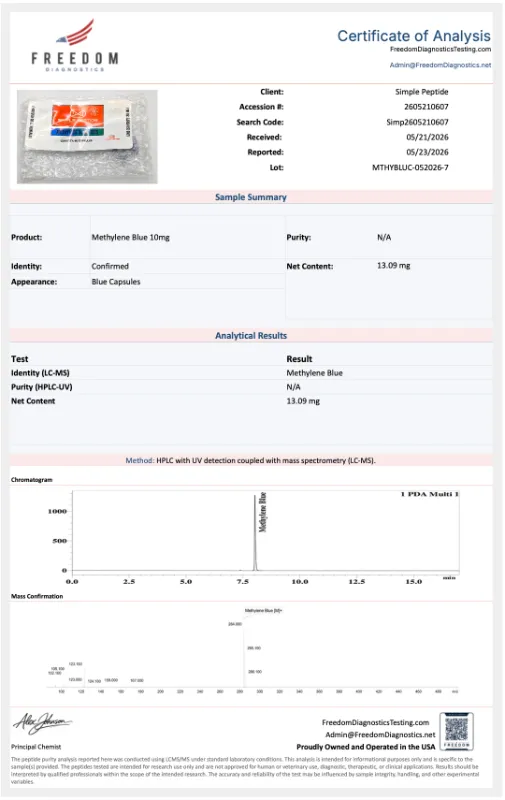
Simple Peptide sends Methylene Blue capsules to an outside lab for identity and purity testing. The COA for the batch is available on request.
For peptides, purity is usually measured by HPLC, which separates a sample into its parts and reports the main compound as a share of the total. Mass spectrometry is often run alongside it to confirm the molecular weight.
Keep a record of the batch number on each bottle. Matching results to batches is the simplest way to rule out the material when an experiment doesn’t behave.
How to store Methylene Blue capsules
Store Methylene Blue capsules sealed, in a cool, dry place out of direct light. A fridge is fine if you keep the lid tight so no condensation gets in. Put the lid back on straight after you take capsules out.
Other NAD+ and mitochondrial peptides to look at
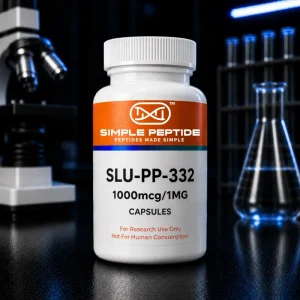
- SLUBAM Capsules (SLU-PP-332 and BAM-15), a capsule format
- NMN Tablets 500mg, a capsule format
- MOTS-c GHK-Cu KPV Blend 85mg, MOTS-c, GHK-Cu and KPV in one vial
- SLU-PP-332 Capsules 250mcg, a capsule format
- ATX-304 (O-304) Capsules 100mg, a capsule format
Browse the full NAD+ and mitochondrial peptides and nootropic peptides range, see every vial on our research peptides page or head back to the Simple Peptide home page.
Methylene Blue capsules FAQ
Are Methylene Blue capsules third-party tested?
Yes. Every batch is third-party tested, and the Certificate of Analysis is available on request.
How much is in each capsule of Methylene Blue capsules?
10mg Methylene Blue.
Do the capsules need mixing?
No. They’re ready to use as they are, with no reconstitution step.
Can Methylene Blue be used in people or animals?
No. It’s sold for laboratory research only and isn’t approved for human or veterinary use.
Are Methylene Blue capsules in stock?
Yes. Methylene Blue capsules are in stock and ready to ship.
Buy Methylene Blue capsules online
Methylene Blue capsules are in stock at $79.00. Add it to the cart, enter code SIMPLE10 at checkout for 10% off, and shipping is free worldwide.
Stocking up for a longer study? Choose 5 bottles or 10 bottles from the Quantity menu to save 5% or 10% on the single price. Need more for the same project? See the rest of our NAD+ and mitochondrial peptides and nootropic peptides, or go back to the Simple Peptide home page.
For laboratory research use only. Not for human or veterinary use. These statements have not been evaluated by the FDA.
Reviews
There are no reviews yet.