
Description
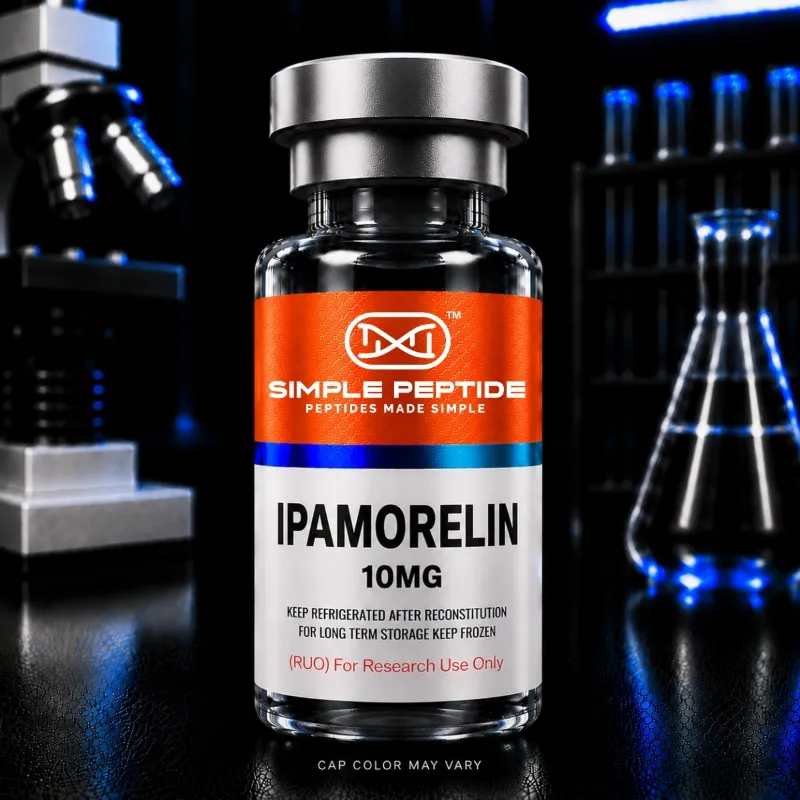
Ipamorelin 10mg from Simple Peptide is 10mg of Ipamorelin in a sealed glass vial. Ipamorelin is a growth hormone secretagogue. It’s for in-vitro and lab research only.
Ipamorelin at a glance
Ipamorelin is a five-amino-acid growth hormone secretagogue, Aib-His-D-2Nal-D-Phe-Lys-NH2, developed at Novo Nordisk in the 1990s. It acts on the ghrelin receptor (GHS-R1a) on pituitary cells.
It was the first compound in its class shown to release GH selectively, without the rise in cortisol and prolactin that earlier GHRPs caused.
How Ipamorelin works
Ipamorelin mimics ghrelin at the growth hormone secretagogue receptor (GHSR-1a) in the pituitary and hypothalamus. Activating that receptor triggers a GH pulse.
Older secretagogues like GHRP-6 also raised cortisol, prolactin and appetite. Ipamorelin is much more selective, which is why it’s the usual choice when GH release is the only thing being studied.
Ipamorelin 10mg specifications
- Compound: Ipamorelin
- CAS number: 170851-70-4
- Molecular formula: C38H49N9O5
- Molar mass: 711.9 g/mol
- Sequence: Aib-His-D-2Nal-D-Phe-Lys-NH2
- Amount: 10mg per vial
- Form: lyophilized (freeze-dried) powder
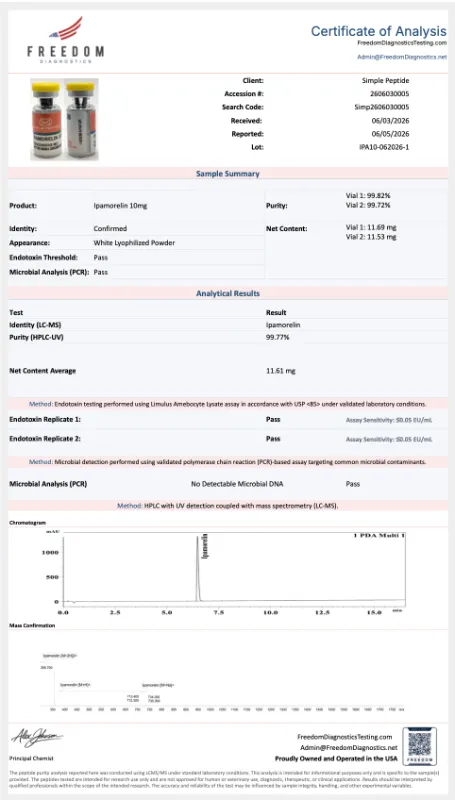
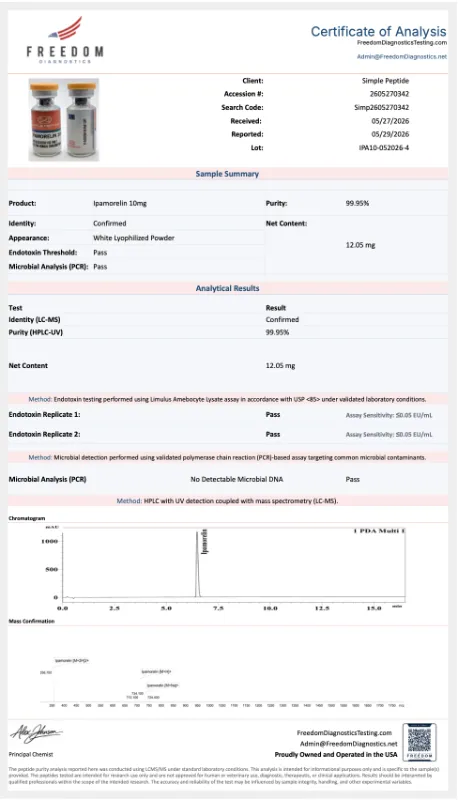
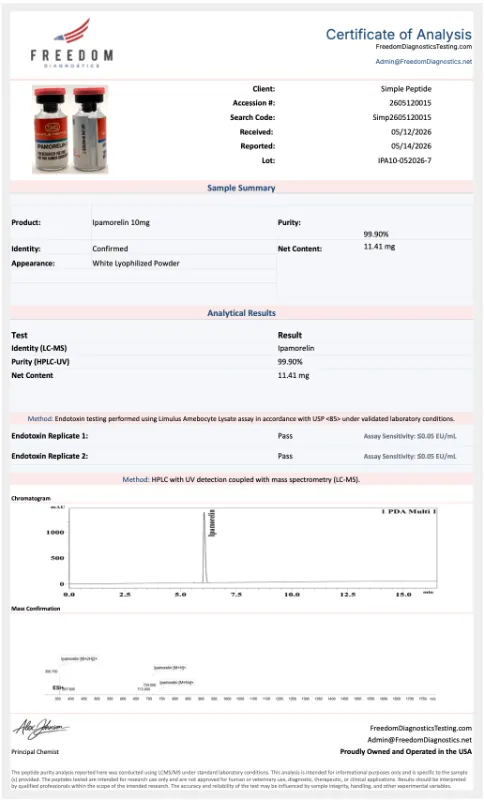
- Testing: third-party tested
- Documentation: Certificate of Analysis available
- SKU: SP-IPA-10
- Use: laboratory research only
What the research says about Ipamorelin
Raun and colleagues described it in the European Journal of Endocrinology in 1998, reporting that even at doses far above those needed for GH release, it didn’t raise ACTH or cortisol in pigs.
It later went into human trials for post-surgical ileus, a stalled gut after abdominal surgery, but didn’t progress to approval.
To read the papers yourself, start with this PubMed search for Ipamorelin.
How Ipamorelin compares
Here’s how Ipamorelin 10mg fits among related compounds. Ipamorelin is the most selective ghrelin-receptor peptide, with little effect on cortisol or prolactin. By comparison:
- CJC-1295 No DAC is a stabilized GHRH(1-29) with a half-life of about 30 minutes, giving short, natural-looking pulses
- CJC-1295 DAC binds albumin and lasts about a week, giving a raised GH baseline instead of short pulses
- Sermorelin is the unmodified first 29 amino acids of GHRH, broken down within minutes
- Tesamorelin is full-length GHRH with a fatty acid cap, the only GHRH analog currently approved as a drug in the US
- GHRP-2 is the strongest GH releaser of the original GHRPs, with a milder appetite effect than GHRP-6
- GHRP-6 releases GH and strongly raises appetite, the classic tool for feeding research
The GHRH analogs (CJC-1295, sermorelin, tesamorelin) all act on the same receptor, and the real difference is how long each one lasts. Ipamorelin, GHRP-2 and GHRP-6 work on the ghrelin receptor instead, which is why labs so often pair one from each side. See them all on our growth hormone peptides page.
Ipamorelin in other formats
Ipamorelin also comes in these products, in case a different format suits your study better:
- Ipamorelin CJC-1295 Blend 10mg (blend vial, $65.00)
- Tesamorelin Ipamorelin Blend 12mg/2mg (blend vial, $109.00)
Ipamorelin 10mg purity and lab testing
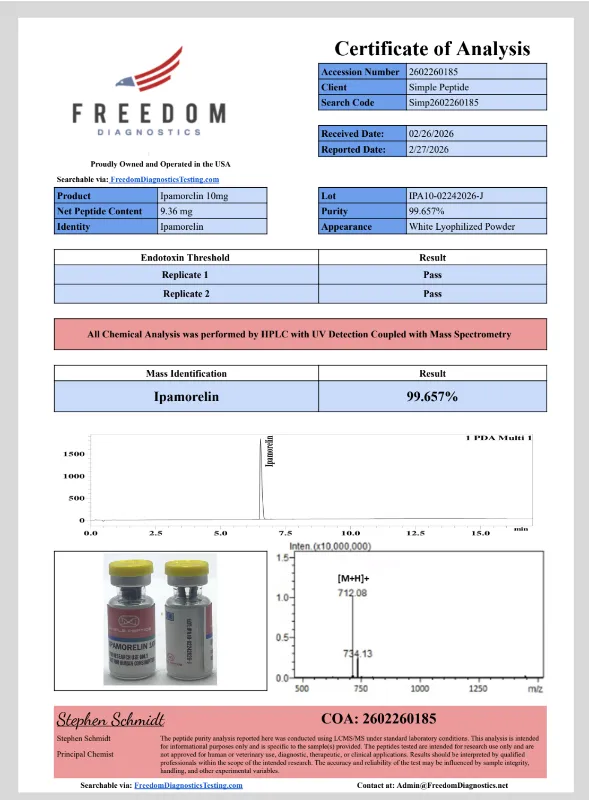
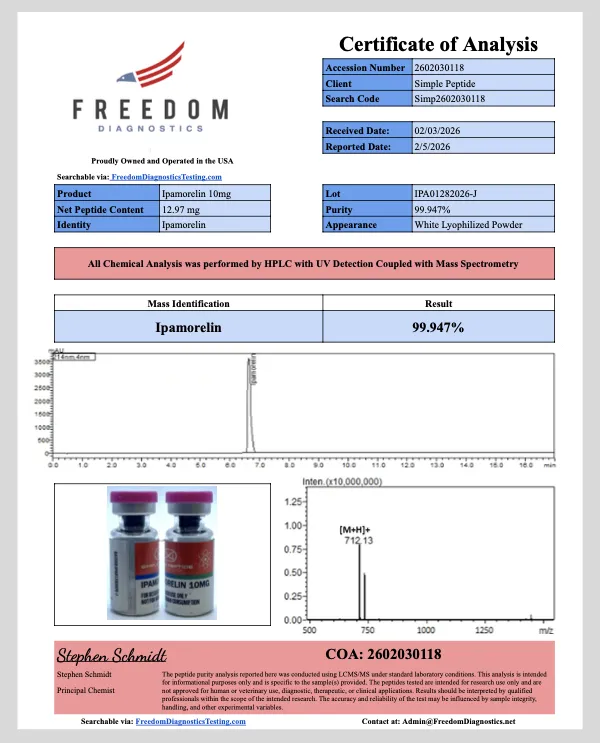
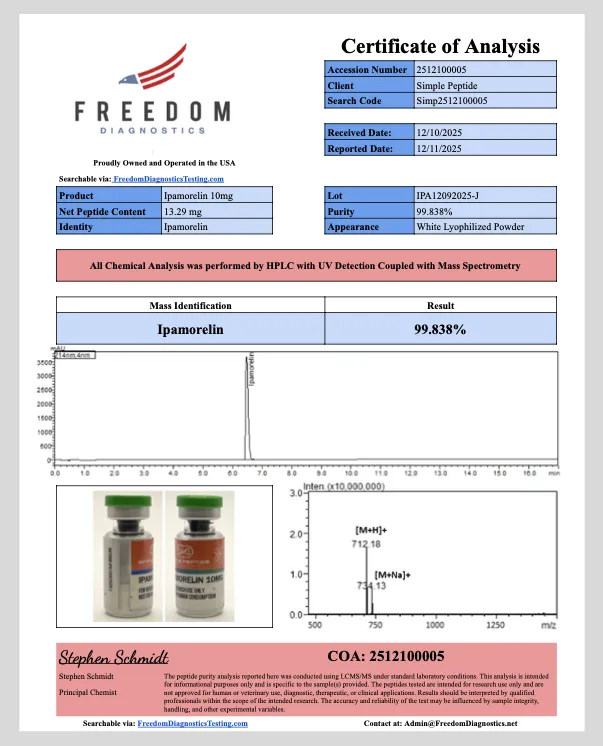
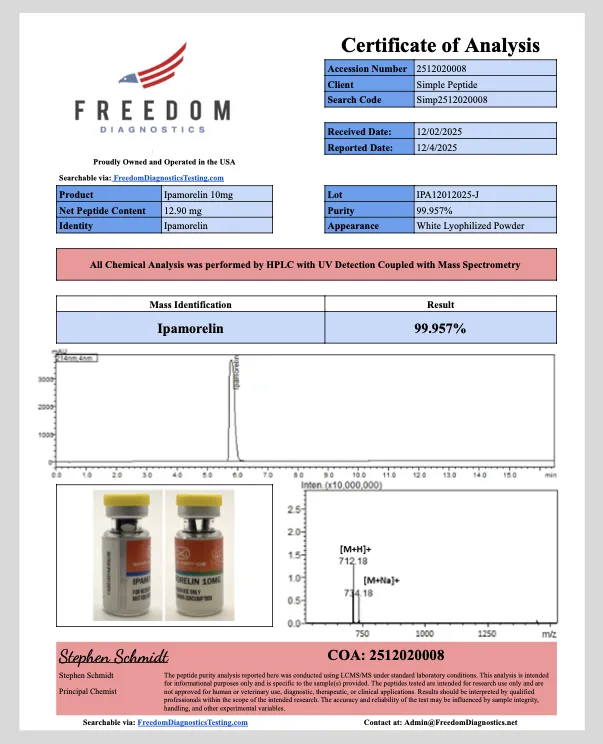
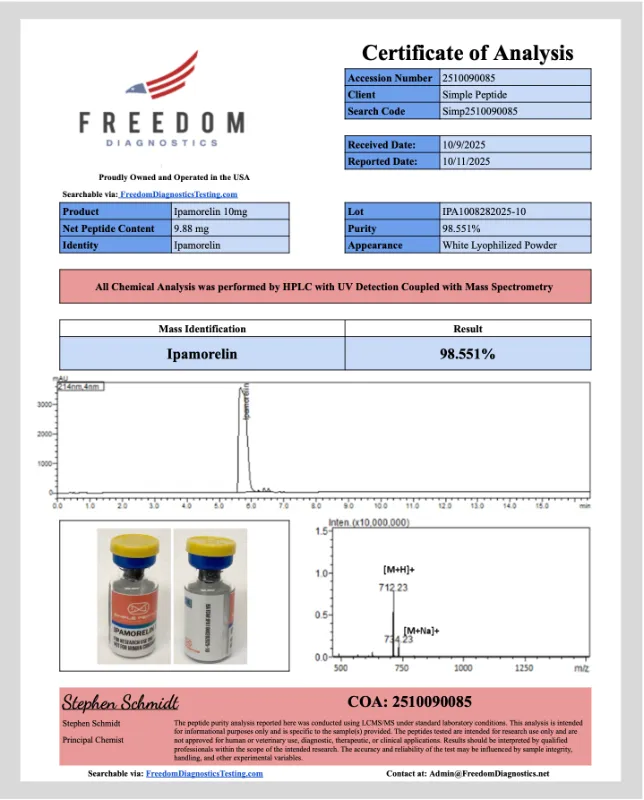
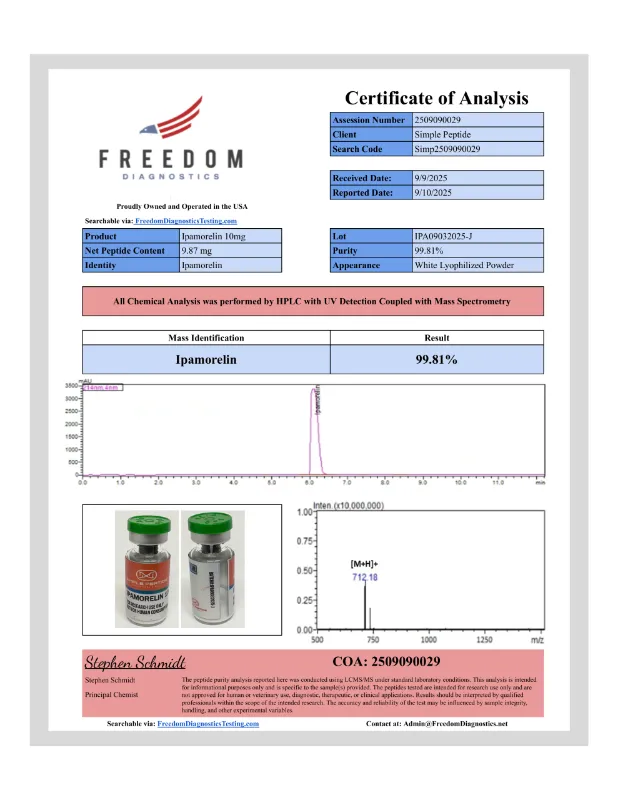
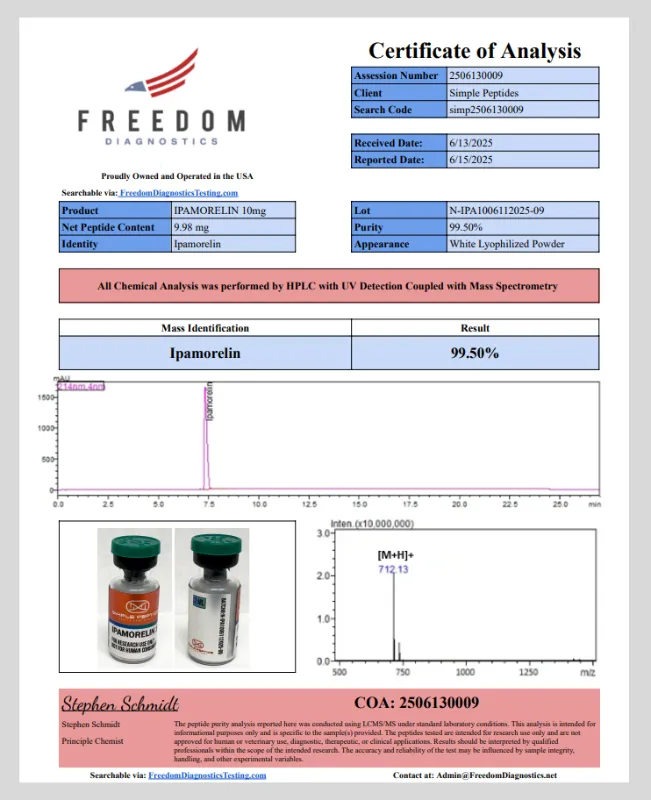
Simple Peptide sends Ipamorelin 10mg to an outside lab for identity and purity testing. The COA for the batch is available on request.
Labs normally confirm identity with mass spectrometry, which checks the molecular weight, and measure purity with HPLC, which separates the main compound from anything else in the sample.
Keep a record of the batch number on each vial. Matching results to batches is the simplest way to rule out the material when an experiment doesn’t behave.
Reconstituting Ipamorelin 10mg
The amount of liquid you add sets the concentration. For a vial holding 10mg:
- 1mL of bacteriostatic water gives 10mg/mL
- 2mL of bacteriostatic water gives 5mg/mL
- 3mL of bacteriostatic water gives 3.33mg/mL
Choose the volume that suits your measurements. Mark the vial with the concentration and date so nobody has to guess later.
Bacteriostatic water is the usual choice, and 0.6% acetic acid helps with peptides that won’t dissolve in water alone. Add it slowly so it runs down the side of the vial, then swirl or roll until everything dissolves. Shaking can shear peptide chains. Skip it.
How to store Ipamorelin 10mg
The dry powder keeps best cold and dark. A freezer at -20°C is right for long-term storage. After reconstitution, store it in the fridge at 2 to 8°C and finish it within roughly four weeks.
Let a frozen vial warm up to room temperature before you open it. Cold glass pulls moisture out of the air, and moisture is what degrades dry peptide.
Other growth hormone peptides to look at
- Tesamorelin 10mg, a GHRH analog
- MGF 2mg, an IGF-1 splice variant peptide
- GHRP-6 10mg, a GH releasing peptide
- PEG-MGF 2mg, a pegylated MGF
- MK-677 Capsules 10mg, a capsule format
Browse the full growth hormone peptides range, see every vial on our research peptides page or head back to the Simple Peptide home page.
Ipamorelin 10mg questions
How much is in the Ipamorelin 10mg vial?
10mg of freeze-dried powder. The amount is printed on the label.
Is Ipamorelin 10mg third-party tested?
Yes. Every batch is third-party tested, and the Certificate of Analysis is available on request.
What do I mix Ipamorelin 10mg with?
Sterile bacteriostatic water is the usual choice. The reconstitution section above shows the concentration for each volume.
How should I store it?
Keep sealed vials in the freezer at -20°C. Once mixed, refrigerate at 2 to 8°C and use within about 28 days.
Can Ipamorelin be used in people or animals?
No. It’s sold for laboratory research only and isn’t approved for human or veterinary use.
Buy Ipamorelin 10mg online
Ready to order? Ipamorelin 10mg costs $65.00 and is in stock. Use code SIMPLE10 for 10% off, and shipping costs nothing wherever you are.
Stocking up for a longer study? Choose 5 vials or 10 vials from the Quantity menu to save 5% or 10% on the single price. Need more for the same project? See the rest of our growth hormone peptides, or go back to the Simple Peptide home page.
For laboratory research use only. Not for human or veterinary use. These statements have not been evaluated by the FDA.
Reviews
There are no reviews yet.